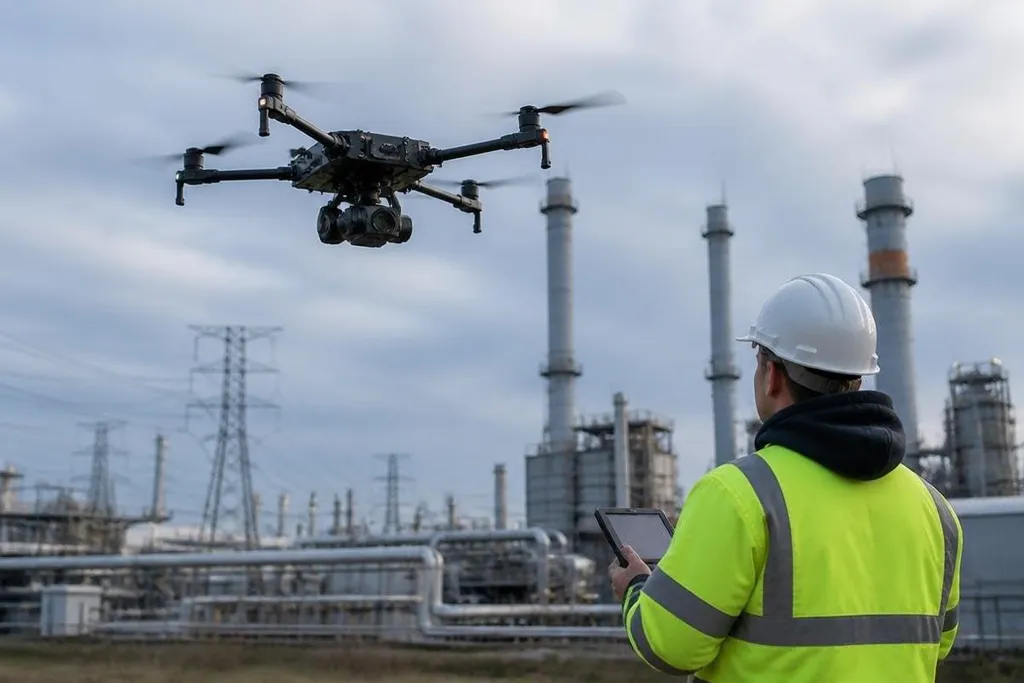
Energy sites are difficult places for people and machines. They include high voltage, heat, radiation, moving equipment, deep water, and long distances. The robotics work worth watching is the work that makes one of those tasks safer, repeatable, or possible from far away.
- Robots that inspect power equipment without sending a technician into danger
- Autonomous machines that maintain solar, wind, and storage sites
- Remote systems for nuclear, offshore, and other hard-to-reach facilities
Inspection without unnecessary exposure
Inspection is a strong starting point because the robot does not need to repair every fault to be useful. It needs to collect clear images, sound, temperature readings, or other sensor data from a place that may be unsafe or expensive to reach.
A useful system would move along a known route, stop at set points, and send back records that people can compare over time. The hard part is keeping those records consistent when light, weather, dust, or equipment position changes.
The proof to watch is simple: can the robot find a fault that a human team would have checked, and can another person review the evidence without seeing the robot in person? A polished video says little if the system cannot repeat the task across a real site.
Maintenance in rough conditions
Cleaning, tightening, lifting, and replacing parts are harder than inspection. Each task needs force, careful positioning, and a way to recover when the object is not where the robot expects it to be.
For solar and wind equipment, the useful question is how much work the robot completes before a person must take over. A machine that carries tools to a work area may still help if it cuts climbing, travel, or exposure time. A machine that needs constant remote control may fit research work better than routine site operations.
Battery life also matters. A robot that spends much of its shift returning to a charger may leave the difficult work to people. Any serious claim should state the task, the distance covered, the load carried, and the amount of remote help required.
Remote work around nuclear and offshore sites
Some energy work cannot be planned like a factory task. Floors may be uneven, maps may be incomplete, and communication may weaken behind walls or across water. A robot in those settings needs clear fault handling and a safe way to stop.
Remote operation can reduce exposure, but it moves part of the problem to the control room.
Operators need useful camera views, stable communication, and controls that match the robot’s movement. The system also needs a recovery plan for a stuck arm, a failed sensor, or a lost connection.
A lab result can look useful until heat, dust, or a lost signal stops the task. Reports such as energy robotics reporting fromRobot24.com put the machine, test site, date, and measured result beside each claim, which gives the full maintenance job a fair test.
The most useful reports will show the full task, including setup, pauses, failed attempts, and human intervention. A short clip of a robot holding a tool cannot answer whether it can work through a full maintenance job.
Storage and emergency response
Energy storage brings another set of tasks. Robots may inspect containers, watch for heat changes, carry sensors, or enter areas after an incident. The machine does not need to replace the response team to earn a place there.
A good system could give people earlier information and keep them farther from a hazard. Its limits matter just as much: sensor range, communication, battery time, load capacity, and operation near smoke or heat.
This area needs careful proof because emergency work is hard to repeat for testing. A credible report should explain the test site, the hazard being measured, the robot’s distance from it, and the action taken after the alert.
A practical watchlist
Use these checks when a company announces an energy robot:
- Name the task: inspection, cleaning, repair, transport, or emergency sensing
- Check the setting: indoor, offshore, underground, high voltage, hot, or radioactive
- Ask who controls it: an onboard system, a nearby operator, or a remote team
- Find the failure plan: safe stop, manual recovery, return route, or a second machine
- Measure the work: time on task, distance, payload, sensor record, and human input
I'd watch systems that can repeat a useful task with little remote help. That is a harder test than a smooth demonstration, and it gives energy operators a number they can use when deciding where a robot belongs.
The next meaningful proof will come from complete work records: what the robot did, where it stopped, how often a person stepped in, and whether the site kept using it after the trial.